
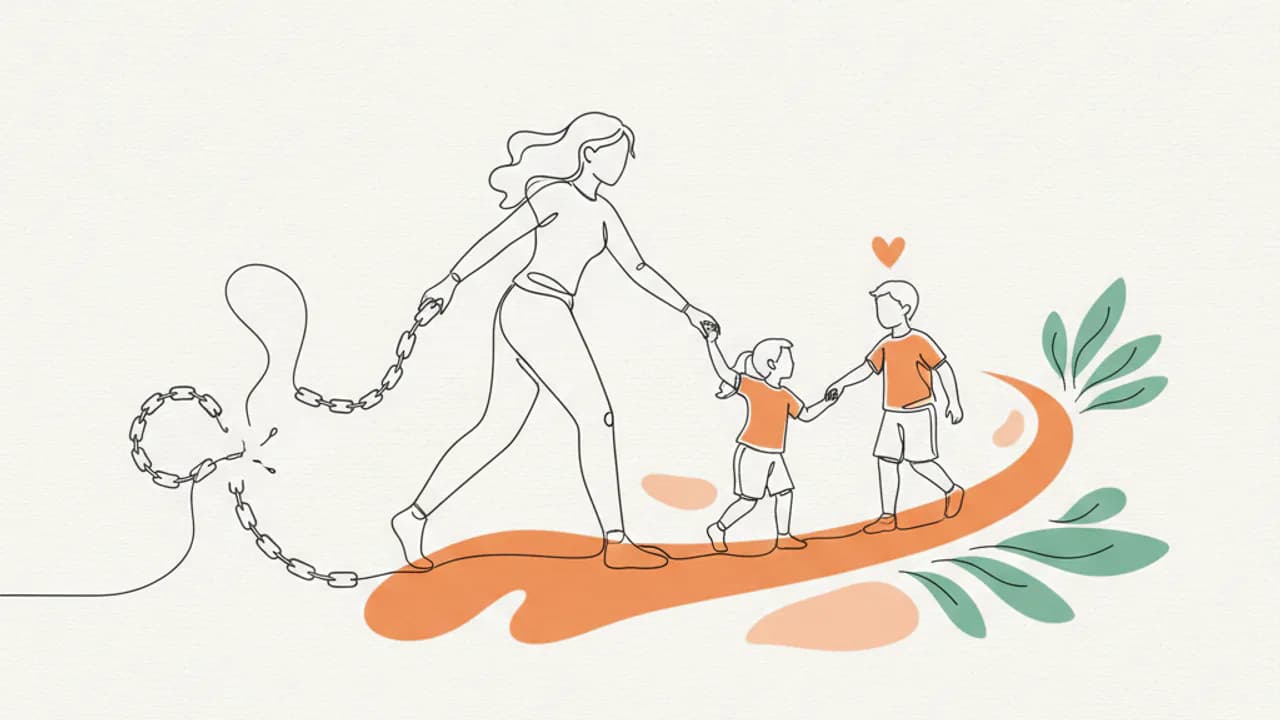
Cycle-breaking parenting means consciously choosing to parent differently than you were raised -- replacing patterns like yelling, emotional unavailability, or corporal punishment with healthier approaches. The term has gained momentum as millennial and Gen Z parents name what they're doing: breaking generational cycles of harm while building new patterns of connection and respect. Research on Adverse Childhood Experiences (ACEs) and neuroplasticity confirms that intergenerational patterns can be interrupted -- and that the effort to change them is one of the most meaningful things a parent can do. It's also one of the hardest, which is why many cycle-breakers work with a parenting coach.
Key Takeaways
- Cycle-breaking is not a parenting method -- it's a motivation. You can break the cycle using positive discipline, gentle parenting, conscious parenting, or any combination that fits your family.
- This is not about blaming your parents. Most parents do the best they can with what they know. Cycle-breaking simply means you have new information and want to use it.
- The science is clear: intergenerational patterns can change. Research on ACEs, attachment theory, and neuroplasticity all show that the brain can build new pathways at any age.
- You will mess up, and that's part of the process. Cycle-breaking isn't about perfection. It's about repair -- what you do after you lose your cool matters more than never losing it.
- Support makes the difference. This work is too hard to do alone. A parenting coach, therapist, support group, or even one friend who gets it can keep you going.
What Is Cycle-Breaking Parenting?
Cycle-breaking parenting is the conscious decision to stop passing down harmful patterns -- not because your parents were bad people, but because you know more and want to do differently.

It's not a formal methodology with a set of rules. There's no certification for it. It's more of an identity and an intention: you look at how you were raised, you identify what hurt, and you choose another path for your children.
What's being "broken" varies from family to family. For some, it's yelling and rage. For others, it's emotional unavailability -- growing up in a home where feelings weren't discussed, where sadness was weakness and anger was the only acceptable emotion. Some cycle-breakers are moving away from corporal punishment. Others are rejecting perfectionism, conditional love, or the unspoken rule that children should be seen and not heard.
And what's being built? Emotional attunement. Respectful discipline. Open communication. The kind of unconditional love that says "I'm here for you" even when -- especially when -- things are hard.
Here's what matters most: cycle-breaking is not about painting your parents as villains. Many cycle-breakers love their parents deeply. They can hold two truths at once -- "My parents did their best with what they had" and "I'm going to do it differently." That's not betrayal. That's growth.
Why "Cycle-Breaking" Is Becoming the Preferred Term
If you've spent any time on parenting social media, you've noticed a shift. The gentle parenting label, once a rallying cry for a new generation of parents, has started to buckle under backlash. Critics say it's permissive. Advocates say it's been misunderstood. And a lot of exhausted parents say they tried it and burned out because the bar felt impossibly high.
Enter cycle-breaking.
According to a 2025 Talker Research / Kiddie Academy survey, roughly 41% of Gen Z parents say "cycle-breaking" or "breaking generational patterns" describes their priority better than any single-method label. The shift makes sense. "Gentle parenting" describes a method. "Cycle-breaking" describes a personal story.
And that distinction matters. When you identify as a cycle-breaker, you're not signing up for a playbook that tells you exactly what to say in every situation. You're naming something deeper: I was raised one way, and I'm choosing another. That identity can hold space for the messiness of real life -- the days you raise your voice, the nights you feel like a failure, the moments when the old patterns surface and you have to fight them back down.
Cycle-breaking acknowledges something gentle parenting often doesn't: this work is painful. It's personal. And it's hard in a way that goes beyond technique.
What You're Breaking -- Common Generational Patterns
Every cycle-breaker's story is different, but certain patterns come up again and again. You might recognize one. You might recognize all of them.
Yelling and rage. "My parents screamed, and their parents screamed before them. I'm learning to pause." If this is your pattern, you're not alone -- it's one of the most common cycles people work to break. Our guide on how to stop yelling at kids walks through specific techniques for building that pause.
Corporal punishment. "I was spanked and I turned out fine" is the phrase cycle-breakers are pushing back on. The American Academy of Pediatrics issued a clear policy statement in 2018 recommending against spanking and all forms of corporal punishment, citing consistent evidence of harm to children's development. Choosing a different path here can feel lonely, especially when extended family disagrees.
Emotional unavailability. "My parents never talked about feelings. I'm learning to name them." Maybe your father showed love through providing but never through words. Maybe your mother kept everything bottled up and expected you to do the same. Breaking this cycle means doing something that might feel completely foreign: sitting with your child's big emotions instead of shutting them down.
Enmeshment. "My parent's emotions were my responsibility. I'm learning boundaries." If you grew up managing a parent's moods -- walking on eggshells, becoming the peacemaker, absorbing their anxiety -- you know what enmeshment feels like. Breaking this cycle means letting your children be children, not emotional caretakers.
Perfectionism and conditional love. "I was only praised for achievements. I'm learning to love unconditionally." Some of us grew up believing we were only as good as our last report card, our last game, our last performance. Cycle-breaking here means telling your child "I love who you are" instead of "I love what you do."
Dismissing children's emotions. The shift from "Stop crying or I'll give you something to cry about" to "I see you're upset -- I'm here." It sounds simple on paper. In practice, when your four-year-old is sobbing because you gave them the wrong color cup, staying present with their feelings takes real effort. But that effort is the work.
The Science Behind Intergenerational Patterns
If you ever wonder whether breaking the cycle actually works -- whether it's worth the effort -- the research says yes. Clearly.
The ACEs study by Felitti and colleagues (1998), published in the American Journal of Preventive Medicine (14(4), 245-258), was groundbreaking. The original study surveyed 9,508 Kaiser Permanente health plan members; subsequent ACE waves and replications have included tens of thousands more. The findings: Adverse Childhood Experiences — things like abuse, neglect, and household dysfunction — predicted health and behavior outcomes not just for the person who experienced them, but across generations. Children of parents with high ACE scores are more likely to have high ACE scores themselves. But here's the part that matters for cycle-breakers: that transmission is not inevitable. It can be interrupted.
Attachment theory, developed by Bowlby (1969) and expanded by Ainsworth, shows that attachment styles pass from parent to child. A parent with an insecure attachment style is more likely to raise a child with an insecure attachment style. But -- and this is the hopeful part -- attachment styles can change. Adults can develop what researchers call "earned secure attachment," meaning they process their childhood experiences and build a secure attachment pattern even if they didn't grow up with one. Dr. Daniel Siegel and Mary Hartzell explore this in Parenting from the Inside Out (2003), showing that a parent's willingness to reflect on their own childhood is one of the strongest predictors of their child's attachment security.
Then there's neuroplasticity. Your brain can rewire at any age. The neural pathways that fire when you default to yelling or withdrawing are strong because they've been reinforced for decades. But new pathways -- the ones that fire when you take a breath, when you stay calm, when you choose connection over control -- get stronger every time you use them. It's like a trail in the woods. The old path is well-worn. The new one takes effort to clear. But the more you walk it, the easier it gets.
Emerging — and contested — research in epigenetics suggests that trauma and healing may have biological mechanisms that cross generations. The most-cited work in this area (Yehuda lineage) is also the most debated; replication and the question of whether human transgenerational epigenetic inheritance is plausible given germline reprogramming remain open. Treat strong claims here with caution. The direction is encouraging, but the science is early.
The bottom line? The cycle can be broken. The brain is built for change. And every time you choose the new path over the old one, you're making it easier -- for yourself and for your children.
How to Start Breaking the Cycle
Knowing you want to break the cycle and knowing how to start are two different things. Here are six practical steps that cycle-breakers come back to again and again.
1. Name what you're changing.
Get specific. "I want to be a better parent" is a wish. "I want to stop yelling when my kids won't listen at bedtime" is a starting point. The more precisely you can name the pattern, the easier it is to spot it in the moment and choose something different. Write it down. Say it out loud. Tell someone.
2. Learn your triggers.
What sends you back to the old patterns? For a lot of parents, it's fatigue. Or defiance. Or feeling disrespected -- because your own parents demanded obedience and that wiring runs deep. Maybe it's sensory overload: the whining, the mess, the noise. Once you know your triggers, you can plan around them instead of being ambushed by them.
3. Build a repair practice.
You will mess up. Every single cycle-breaker does. The difference between you and the previous generation isn't perfection -- it's repair. When you lose your temper, come back. Get on your child's level. Say something like: "I'm sorry I yelled. That wasn't okay. You didn't deserve that. I'm going to try again." Repair isn't a sign of failure. It's the actual work.
4. Find your replacement tools.
You can't just remove a pattern -- you have to replace it with something. If your default is yelling, what's your new default? Maybe it's a deep breath and a script: "I need a moment. I'll be right back." If your default is spanking, what's your replacement? Logical consequences, time-ins, or a calm redirection. If your default is dismissing emotions, your replacement might be a simple "Tell me more about that." You don't have to have it all figured out. Start with one swap.
5. Get support.
This work is too heavy to carry alone. A parenting coach can give you concrete tools and hold you accountable week to week. A therapist can help you process the grief and anger that come up when you start digging into your childhood. A support group -- online or in person -- can remind you that you're not the only one doing this. Even one trusted friend who understands what you're going through can be a lifeline. You don't have to choose just one form of support, and you don't have to do it all at once. But do something.
6. Practice self-compassion.
Here's what nobody tells you about cycle-breaking: it's grief work. You're mourning the childhood you didn't get while simultaneously building the one you wish you'd had. Some days that grief hits out of nowhere -- watching your child receive the tenderness you never got, hearing yourself say the words you needed to hear as a kid. That's heavy. Be gentle with yourself. You're not just parenting your child. You're re-parenting yourself at the same time. That takes something out of you, and it's okay to acknowledge that.
Want practical tools for the changes you're making?
Find a Parenting CoachCycle-Breaking vs Other Parenting Approaches
One of the most freeing things about cycle-breaking is this: it's not a method. It's a motivation.
You can break the cycle using positive discipline -- setting firm, respectful boundaries without punishment. You can break it through gentle parenting -- leading with empathy and connection. You can break it with conscious parenting -- using your relationship with your child as a mirror for your own growth. Or you can mix and match, pulling from whatever approach fits your family, your child's temperament, and your own capacity on any given day.
The approach matters less than the intention. The question isn't "Which method is the right one?" It's "Am I doing something different from what was done to me?"
For a deeper look at how different approaches compare, check out our guide to 7 parenting approaches compared. You might find that your cycle-breaking draws from several of them -- and that's perfectly fine. Most parents land somewhere in the overlap.
When Coaching vs Therapy Makes Sense
The hardest part of cycle-breaking is not learning the new tools -- it's managing the grief, guilt, and exhaustion that come from parenting without a model to follow. That emotional weight is real. So how do you know what kind of support to get?
Coaching fits when you know what you want to change and you need practical tools to get there. A parenting coach can help you build scripts for tough moments, identify your triggers, create a plan for specific situations, and hold you accountable as you practice new patterns. Coaching is action-oriented and forward-looking. If your biggest need right now is "help me stop yelling at bedtime" or "teach me how to set boundaries with my toddler without caving," a coach is a strong match.
Therapy fits when your childhood experiences are causing significant emotional distress -- anxiety, depression, PTSD symptoms, flashbacks, or deep grief that makes it hard to function. If digging into your parenting patterns brings up feelings that overwhelm you, that's a sign therapy can help you process what's underneath.
Both fit when you need to heal and build new skills at the same time. And honestly? That's a lot of cycle-breakers. Many do therapy for processing the past and coaching for building the future. The two aren't in competition -- they're complementary.
A coach who understands cycle-breaking can hold space for the emotional weight of this work while still teaching you concrete alternatives. They won't be surprised when you cry in a session about toddler discipline, because they know it's not really about the toddler. It's about everything the toddler is bringing up.
For a detailed comparison, read our guide on parenting coach vs therapist.
Frequently Asked Questions
Am I a cycle-breaker?
If you're consciously choosing to parent differently from how you were raised, and that change is intentional and values-driven -- yes. You don't need a formal diagnosis, a traumatic backstory, or anyone's permission. If you're reading this article and something resonates, that's probably your answer.
Does cycle-breaking mean my parents were bad?
No. It means you have information and resources they didn't. Parenting research has exploded in the last 30 years. Your parents didn't have access to what you have access to. You can honor their effort and still choose a different path -- those two things aren't in conflict.
How do I handle holidays with my parents when I parent differently?
This is one of the most common and most stressful challenges cycle-breakers face. When your parents see you parenting differently, they can feel judged -- even when that's not your intention. Prepare ahead of time. Set boundaries you can hold without a big speech. Have a few scripts ready: "We're trying something different with bedtime" is enough. You don't owe anyone a defense of your choices. And if it gets overwhelming, take a break. Step outside. Breathe. A parenting coach can help you practice these conversations before they happen.
Why is cycle-breaking so exhausting?
Because you're building new patterns without a model. Neurologically, new neural pathways require more energy than automatic ones -- your brain is working overtime to override deeply ingrained defaults. Add in the emotional weight of processing your own childhood while raising your children, and it makes sense that you're tired. The good news: it does get easier. The new pathways strengthen over time. This exhaustion is temporary, even when it doesn't feel like it.
Can I break the cycle without therapy?
It depends on what you're breaking. If you're changing discipline methods -- moving from yelling to calm responses, from spanking to logical consequences -- coaching and self-education can absolutely get you there. But if your childhood involved abuse, neglect, or trauma that still affects your daily emotional state, therapy is more appropriate for processing that pain. Be honest with yourself about what you need. There's no shame in needing clinical support -- it's actually one of the bravest things you can do.
How do I know if I'm actually breaking the cycle?
Your children will tell you -- through their behavior, their trust, and eventually their words. If your child feels safe expressing emotions around you, that's a sign. If they come to you when they're scared instead of hiding, that's a sign. If they trust that your love isn't conditional on their performance, that's a sign. You won't see it all at once. But the evidence shows up in small moments, over time. And someday, years from now, they might thank you for it. Or they might not -- they might just raise their own kids with the patterns you gave them, never knowing how hard you worked to build something different. Either way, you changed the story.
Discover your Cycle-Breaker Profile across 6 dimensions of generational change.
Take the Free AssessmentYou don't have to figure this out alone.
Browse Parenting CoachesThis article is for informational purposes only and does not constitute professional medical, psychological, or therapeutic advice. If you or your child are experiencing a mental health crisis, contact your healthcare provider or your local crisis line.
Sources:
- Felitti, V. J., et al. (1998). Relationship of Childhood Abuse and Household Dysfunction to Many of the Leading Causes of Death in Adults. American Journal of Preventive Medicine, 14(4), 245-258.
- Bowlby, J. (1969). Attachment and Loss: Vol. 1. Attachment. Basic Books.
- Siegel, D. J., & Hartzell, M. (2003). Parenting from the Inside Out. Tarcher/Putnam.
- Talker Research / Kiddie Academy. (2025). Modern parenting shifts: Cycle-breaking takes top priority.
- Roisman, G. I., Padrón, E., Sroufe, L. A., & Egeland, B. (2002). Earned-secure attachment status in retrospect and prospect. Child Development, 73(4), 1204-1219.
- American Academy of Pediatrics. (2018). Effective Discipline to Raise Healthy Children. Pediatrics, 142(6).